
what do you see in the water?
reflecting on: the feeling of the past and art history

Sometimes, when I enter a library with books older than a few centuries, I start thinking of the changes the world has gone through since the pages lying there on the shelves have been conceived in the minds of other human beings and I feel myself shaken by a sense of vertigo. And if I take one of those books in my hands and start reading, this familiar action, I feel as though I was walking through a mysterious and unfamiliar threshold into unkown territories.
We often suppose that knowing the history of a certain epoch allows us insight into the minds of the people who lived through them, but something like a whole lived experience forever separates us from the comprehension of that mysterious turn of the phrase or the progression of a line of thought. How much don’t we know, or better, how much can we not even imagine about the lives of those people, from past nearer and more distant, since we have not lived through the same experience of the world?
I used to often ask myself this question while reading poetry, trying to comprehend the different words that flowed from different poets through time. It’s also deep question when studying art history. We often undervalue how deeply aesthetic expression, taste and convention subtly express an energy and a way of living in the world that changes both individually and from epoch to epoch. It’s not a question of overstating the importance of psychology in the form and content of artistic output, making the gross mistake of overlooking the intellectual, technical and constructed side of artistic expression.
Instead it’s the possibility for the attentive eye, once all these aspects have been examined and understood, to come to a moment where a fresher view into the artist’s intent shines through the complex interplay of material, social, intellectual, emotional and spiritual. There is a mysterious point, that comes through all the more effectively the more a piece of art has achieved communicative purity and avoided contrivedness, that lets shine forth a piece of content that, once grasped, expresses the purest point of content - the work of art’s final word, so to say. It’s important for this reason that each work of art must be judged in the context of its times and once this starts to happen, the insights that open up in front of the mind are much more original than what could’ve been achieved by simple distant observation.
If I’m allowed one pretentious mental image, art history is about plunging into an artwork like the man in the beautiful Tomb of the Diver of Paestum. One hypothesis about the subject of this much debated tomb fresco is that the young man is leaping in the otherworld after death. Yet if you look at him, he leaps naturally and gracefully, as if conscious of his ability to experience the shining door to the unknown and maybe, maybe re-emerge in a new form. What a strange image, to see death as a gleaming surface of water, whose surface can be broken and under whose cover we can still open our eyes and see.
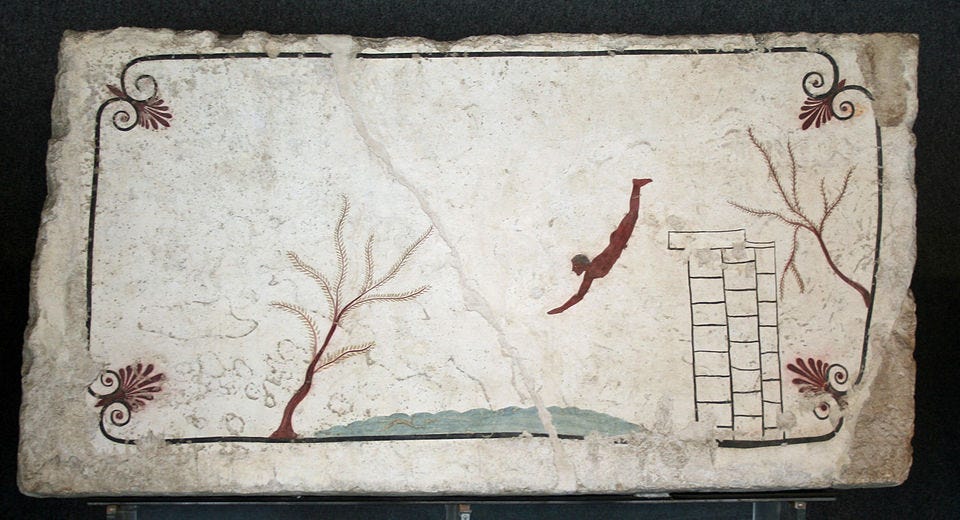
In some way, in a similar form, each work of art can stand out to our attention as something unknown and distant, yet shining in its appeal and open to our entering its inner condition and transforming our habits of movement and sight. And maybe (please look past the rethoric quality of this sentence and try to follow the feeling of it), in this way we will be able to, for a bright moment, to partially look beyond the veil of time and experience.
What speaks to me from the stone, the paper, the symbol and the plain image, the colour, the letter, the form? What do they bring towards me?